

CSAT MOCK PRACTICE PAPER
Time Allowed: 2 Hours | Total Questions: 80 | Full Marks: 200
Passage 1
A moral concept of politics lays emphasis on the individual and on as much as possible to the individual’s self-realization. This requires a certain degree of freedom. But what is freedom? This is a question that has been asked since the dawn of civilization. It is often said that freedom is the absence of constraints. But this is a very narrow view of freedom. In a deeper sense, freedom is the opportunity to develop one’s potential to the fullest. It is not just about being free from something, but being free to do something.
1. With reference to the passage, which of the following statements is correct?
(a) Politics should not be concerned with moral concepts.
(b) Freedom is merely the absence of any kind of constraints on the individual.
(c) The realization of an individual’s potential is the true essence of freedom.
(d) Self-realization is possible even in the absence of freedom.
2. Two ports A and B are 300 km apart. Two ships leave A for B such that the second leaves 8 hours after the first. The ships arrive at B simultaneously. Find the time the slower ship spent on the trip if the speed of one of them is 10 km/h higher than that of the other.
(a) 25 hours
(b) 15 hours
(c) 10 hours
(d) 20 hours
3. A and B travel the same distance at the rate of 8 km/h and 10 km/h respectively. If A takes 30 minutes longer than B, the distance travelled by B is:
(a) 6 km
(b) 10 km
(c) 16 km
(d) 20 km
4. Two trains for Patna leave Delhi at 6:00 a.m. and 6:45 a.m. and travel at 98 km/h and 136 km/h respectively. How many kilometres from Delhi will the two trains meet?
(a) 262.4 km
(b) 260 km
(c) 200 km
(d) None of these
5. Find the next number in the following series: 325, 259, 204, 160, 127, 105, ?
(a) 94
(b) 92
(c) 85
(d) 84
Passage 2
The cumulative effect of various factors—physical, chemical, and biological—on the environment is well known. The most important among these is the impact of human activities on the environment. In the past, the environment was able to maintain its equilibrium despite the changes. However, in recent times, the scale and intensity of human activities have increased to such an extent that the environment is no longer able to maintain its balance. The depletion of the ozone layer, global warming, and the loss of biodiversity are all manifestations of this imbalance.
6. According to the passage, the environment is unable to maintain its equilibrium because:
(a) Natural factors have become more unpredictable.
(b) The scale of human interference has exceeded the environment’s self-regulatory capacity.
(c) Biodiversity is inherently unstable.
(d) Physical and chemical factors are more potent than biological factors.
7. What is the most logical and crucial message given by the passage?
(a) Human activities must be stopped to save the environment.
(b) The environment was more resilient in the past than it is now.
(c) There is an urgent need to re-evaluate the scale and intensity of human activities.
(d) Global warming is the most dangerous result of environmental imbalance.
8. Two trains A and B start from station X to Y and Y to X respectively. After passing each other, they take 12 hours and 3 hours to reach Y and X respectively. If train A is moving at a speed of 48 km/h, the speed of train B is:
(a) 24 km/h
(b) 96 km/h
(c) 21 km/h
(d) 20 km/h
9. X and Y are two stations 600 km apart. A train starts from X towards Y at the rate of 25 km/h. Another train starts from Y at the rate of 35 km/h. How far from X will they cross each other?
(a) 250 km
(b) 300 km
(c) 450 km
(d) 475 km
10. Sujit covers a distance in 40 minutes if he drives at a speed of 60 km/h on an average. Find the speed at which he must drive to reduce the journey time by 25%.
(a) 60 km/h
(b) 70 km/h
(c) 75 km/h
(d) 80 km/h
Passage 3
Economic growth is a necessary but not a sufficient condition for the eradication of poverty. While growth creates resources, the way these resources are distributed determines the level of poverty. If growth is concentrated in sectors that do not employ the poor, or if the benefits are captured by a small section of society, poverty may persist despite a high growth rate. Therefore, policies must focus on “inclusive growth” that ensures the participation and benefit of the marginalized sections of society.
11. Which of the following is the most logical corollary to the above passage?
(a) Poverty can be removed only by stopping economic growth.
(b) High growth rate is a guarantee for poverty reduction.
(c) Distributional aspects of growth are as important as the growth rate itself.
(d) Inclusive growth is possible only in a socialist economy.
12. What does the author imply by “inclusive growth”?
(a) Growth that involves all sectors like agriculture, industry, and services.
(b) Growth that focuses exclusively on the rural poor.
(c) Growth where the marginalized sections are active participants and beneficiaries.
(d) Growth that is controlled by the government.
13. Manish travels a certain distance by car at the rate of 12 km/h and walks back at the rate of 3 km/h. The whole journey took 5 hours. What is the distance he covered by car?
(a) 12 km
(b) 30 km
(c) 15 km
(d) 6 km
14. After how many years will a sum of ₹12,500 become ₹17,500 at the rate of 10% per annum simple interest?
(a) 2 years
(b) 3 years
(c) 4 years
(d) 5 years
15. Interest obtained on a sum of ₹2,000 for 3 years is ₹300. Find the rate of interest per annum.
(a) 7%
(b) 6%
(c) 5%
(d) 10%
16. Find the rate of interest if the amount after 2 years of simple interest on a capital of ₹1,200 is ₹1,440.
(a) 8%
(b) 9%
(c) 10%
(d) 11%
Passage 4
The search for a single, universal definition of “species” has been a long-standing challenge in biology. Traditionally, a species is defined as a group of organisms that can interbreed and produce fertile offspring. However, this definition does not apply to organisms that reproduce asexually. Furthermore, the discovery of hybridization between different species has further complicated the matter. Some scientists now suggest a more pluralistic approach, using different criteria for different groups of organisms.
17. The “traditional” definition of species is problematic because:
(a) It is too simple for complex organisms.
(b) It cannot be applied to organisms that do not reproduce sexually.
(c) It ignores the role of genetic mutations.
(d) It is based on interbreeding, which never happens in nature.
18. A “pluralistic approach” to defining species implies:
(a) Finding one single definition that fits all organisms.
(b) Using different sets of criteria depending on the type of organism.
(c) Ignoring the concept of species altogether.
(d) Relying only on DNA sequencing for all definitions.
19. A railway passenger counts the telegraph poles on the railway track as he passes them. The poles are at a distance of 50 metres. What will be his count in 4 hours, if the speed of the train is 45 km/h?
(a) 600
(b) 2500
(c) 3600
(d) 5000
20. Find the next number in the following series: 8, 8, 9, 9, 11, 10, 14, 11, ?
(a) 14
(b) 15
(c) 18
(d) 20
21. Find the next number in the following series: 8, 14, 26, 50, 98, 194, ?
(a) 382
(b) 386
(c) 390
(d) 194
Passage 5
The rapid expansion of the internet has transformed the way we communicate. However, it has also created new challenges, particularly in the realm of privacy. Personal data is now a valuable commodity, and its unauthorized use has become a major concern. Cybercrime is on the rise, and traditional legal frameworks are often inadequate to deal with these new forms of crime.
22. The passage suggests that the internet has:
(a) Made communication more difficult.
(b) Resulted in a trade-off between convenience and privacy.
(c) Eliminated the need for legal frameworks.
(d) Made personal data less important than before.
23. Why are traditional legal frameworks “inadequate”?
(a) Because they are too old to be understood.
(b) Because cybercrime is a new phenomenon that crosses national boundaries.
(c) Because the internet cannot be regulated.
(d) Because hackers are more intelligent than lawyers.
24. A journey of 192 km takes 2 hours less by a fast train than by a slow train. If the average speed of the slow train is 16 km/h less than that of the fast train, what is the average speed of the faster train?
(a) 32 km/h
(b) 16 km/h
(c) 12 km/h
(d) 48 km/h
25. A train moves at a constant speed of 120 km/h for one kilometre and at 40 km/h for the next one kilometre. What is the average speed of the train?
(a) 48 km/h
(b) 50 km/h
(c) 80 km/h
(d) 60 km/h
26. A dishonest dealer professes to sell at cost price but uses a 800 gram weight instead of a 1 kilogram weight. Find the percent profit to the dealer.
(a) 25%
(b) 20%
(c) 12.5%
(d) None of these
27. Ajay borrows ₹1500 from two moneylenders. He pays interest at 12% p.a. for one loan and 14% p.a. for the other. The total interest for the year is ₹186. How much does he borrow at 12%?
(a) ₹1200
(b) ₹1300
(c) ₹1400
(d) ₹300
Passage 6
The modern democratic state has been built on the principle of the separation of powers among the legislature, the executive, and the judiciary. The objective is to ensure a system of checks and balances so that no single branch becomes too powerful. However, in practice, the executive often tends to dominate the other branches, leading to a dilution of democratic principles.
28. What is the primary purpose of the “separation of powers”?
(a) To make the government work faster.
(b) To ensure that the judiciary is the most powerful branch.
(c) To prevent the concentration of power in any one branch.
(d) To eliminate the need for elections.
29. The “dilution of democratic principles” occurs when:
(a) The legislature passes too many laws.
(b) The executive overpowers the legislature and the judiciary.
(c) The judiciary refuses to interfere in political matters.
(d) People stop voting in elections.
30. A man sells a table set for ₹66,000 and makes a profit of 10%. He sells another table at a loss of 20%. If on the whole, he neither gains nor loses, find the selling price of the second table.
(a) ₹45,000
(b) ₹42,000
(c) ₹30,000
(d) ₹24,000
31. A dealer allowed a discount of 25% on the marked price of ₹12,000 on an article and incurred a loss of 10%. What discount should he allow on the marked price so that he gains ₹440 on the article?
(a) 11%
(b) 13%
(c) 19%
(d) 15%
32. A Camera shop allows a discount of 15% on the advertised price of a camera. What price must be marked on the camera, that costs ₹600, so that he makes a profit of 19%?
(a) ₹840
(b) ₹820
(c) ₹750
(d) ₹880
Passage 7
Agriculture remains the backbone of the Indian economy, providing employment to a large section of the population. However, the sector is facing several challenges, including fragmented landholdings, lack of access to credit, and the impact of climate change. To ensure food security, there is an urgent need for technological intervention and policy reforms that support small and marginal farmers.
33. According to the passage, why is food security at risk?
(a) Because people are eating more than before.
(b) Due to structural and environmental challenges in the agricultural sector.
(c) Because India is exporting too much food.
(d) Because farmers are moving to cities.
34. The author suggests that reforms should specifically target:
(a) Large-scale corporate farmers.
(b) Small and marginal farmers.
(c) The urban food distribution system.
(d) The import of foreign seeds.
35. The cost price of 40 Oranges is equal to the selling price of 30 Oranges. Find the percentage profit.
(a) 20%
(b) 25%
(c) 33.33%
(d) None of these
36. A owns a bike worth ₹40,000. He sells it to B at a profit of 10%. After some time, B sells it back to A at 20% loss. Find A’s total gain.
(a) ₹11,000
(b) ₹8,800
(c) ₹12,000
(d) ₹4,400
37. A shopkeeper bought locks at the rate of 8 locks for ₹34 and sold them at the rate of 12 locks for ₹57. Calculate his gain percent.
(a) 9.33%
(b) 12.5%
(c) 11.11%
(d) 11.76%
38. By selling a bouquet for ₹690, a florist gains 15%. At what price should he sell the bouquets to gain 25% on the cost price?
(a) ₹720
(b) ₹750
(c) ₹660
(d) ₹780
39. A shopkeeper bought 480 chocolates at ₹6 per dozen. If he sold all of them at ₹0.75 each, what was his profit per cent?
(a) 50%
(b) 33.33%
(c) 75%
(d) 20%
Passage 8
Education is not merely the acquisition of knowledge but the development of a critical mind. A system that emphasizes rote learning and memorization fails to prepare students for the complexities of the real world. True education should encourage students to question, to analyze, and to think independently.
40. The author’s main criticism of the current education system is that:
(a) It is too expensive.
(b) It focuses on memorization rather than critical thinking.
(c) It does not teach enough subjects.
(d) It is not available in rural areas.
41. Which of the following is an attribute of “true education” according to the passage?
(a) The ability to memorize large amounts of data.
(b) Obtaining high marks in examinations.
(c) Developing independent and analytical thinking skills.
(d) Following the teacher’s instructions without question.
42. The cost of production of a shirt in 2019 was ₹2200, divided between material, labour and overheads in the ratio 4 : 5 : 2. If the shirt is marked at a price that gives a 10% profit on the component of labor, what is the marked price?
(a) ₹2280
(b) ₹2300
(c) ₹2120
(d) ₹2310
43. In the Delhi zoo, there are lions and there are hens. If the heads are counted, there are 180, while the legs are 448. What will be the number of lions in the zoo?
(a) 36
(b) 88
(c) 44
(d) 136
44. A dishonest shopkeeper purchased milk at ₹100 per litre and mixed 10 liters of water in it. By selling the mixture at the rate of ₹100 per litre he earns a profit of 25%. The quantity of the amount of the mixture that he had was:
(a) 50 liters
(b) 40 liters
(c) 25 liters
(d) 60 liters
45. A tank has a capacity of 10 gallons and is full of alcohol. 2 gallons are drawn out and filled with water. This process is repeated 5 times. How much alcohol is left finally?
(a) 2048/625 gallons
(b) 3346/625 gallons
(c) 2048/3125 gallons
(d) 1024/625 gallons
Passage 9
Urbanization is an inevitable consequence of economic development. As countries move from agrarian to industrial and service-based economies, people migrate to cities in search of better opportunities. However, rapid and unplanned urbanization leads to the growth of slums, inadequate public services, and environmental degradation.
46. Urbanization is described as “inevitable” because:
(a) People naturally prefer city life.
(b) It is linked to the structural shift in the economy.
(c) Governments force people to move to cities.
(d) Agriculture is no longer possible.
47. What is the consequence of “unplanned urbanization”?
(a) Better economic opportunities for everyone.
(b) The collapse of the industrial sector.
(c) Deterioration in the quality of urban life and services.
(d) A return to agrarian society.
48. By selling a book for ₹1080, a shopkeeper incurs a loss of 10%. Find the cost price of the book.
(a) ₹1200
(b) ₹1300
(c) ₹1280
(d) ₹1240
49. How many kilograms of salt worth ₹360 per kg should be mixed with 10 kg of salt worth ₹420 per kg, such that by selling the mixture at ₹480 per kg, there is a gain of 20%?
(a) 5 kg
(b) 3 kg
(c) 2 kg
(d) 4 kg
50. A total of 800 students appeared for an exam. 50% of boys and 90% of girls cleared the cut-off. If the overall percentage qualified is 60%, how many girls appeared?
(a) 100
(b) 120
(c) 150
(d) 200
51. After 5 years, the age of a father will be three times the age of his son. Five years ago, the father was seven times as old as his son. What are their present ages?
(a) Father: 35, Son: 10
(b) Father: 40, Son: 10
(c) Father: 42, Son: 12
(d) Father: 45, Son: 15
52. A man can row at 7 km/h in still water. The speed of the stream is 3 km/h. If it takes him 7 hours to row to a place and come back, how far is the place?
(a) 14 km
(b) 18 km
(c) 20 km
(d) 24 km
53. A man swims 30 km downstream and 18 km upstream, taking 3 hours each time. What is the velocity of the current?
(a) 1 km/h
(b) 2 km/h
(c) 3 km/h
(d) 4 km/h
54. The age of a man is four times the age of his son. Five years ago, the man was nine times as old as his son. What is the present age of the man?
(a) 28 years
(b) 30 years
(c) 32 years
(d) 36 years
55. A tower is 200/root 3 m high. The angle of elevation of the top from a point 200 m away from its foot is:
(a) 30°
(b) 45°
(c) 60°
(d) 90°
56. The angles of depression of two ships from the top of a 100m lighthouse are 45° and 30°. What is the distance between the ships (on the same side)?
(a) 73.2 m
(b) 100 m
(c) 136.6 m
(d) 173.2 m
57. Which of the following numbers does not fit in the series: 14, 19, 29, 40, 44, 51, 59, 73?
(a) 29 (b) 40 (c) 44 (d) 51
58. Pointing to a photograph, a man said, “I have no brother or sister but that man’s father is my father’s son.” Whose photograph was it?
(a) His own (b) His son’s (c) His father’s (d) His nephew’s
59. If ‘WATER’ is written as ‘YCVGT’, then how is ‘HJKLN’ written in that code?
(a) FILJK (b) GHKLM (c) FGHIJ (d) None of these
60. Six persons A, B, C, D, E and F are sitting in a circle facing the center. B is between F and C; A is between E and D; F is to the left of D. Who is between A and F?
(a) B (b) C (c) D (d) E
Passage 10
The quest for a sustainable energy future is no longer a luxury but a necessity. Fossil fuels are finite and their combustion is the primary driver of climate change. Transitioning to renewable sources like solar, wind, and geothermal requires not only technological innovation but also political will and massive financial investment. Developing nations argue that they should not be penalized for the historical emissions of industrialized countries, leading to a complex global debate on “climate justice.”
61. What is the primary barrier to the energy transition according to the passage?
(a) Lack of renewable resources.
(b) Technological, political, and financial constraints.
(c) The refusal of developing nations to participate.
(d) The abundance of fossil fuels.
62. “Climate justice” implies:
(a) Everyone should pay the same for carbon emissions.
(b) Historical polluters should bear a larger burden of the transition.
(c) Developing countries should stop using all energy.
(d) Justice is only possible through legal courts.
63. A clock is started at noon. By 10 minutes past 5, the hour hand has turned through:
(a) 145° (b) 150° (c) 155° (d) 160°
64. A, B and C can do a piece of work in 20, 30 and 60 days respectively. In how many days can A do the work if he is assisted by B and C on every third day?
(a) 12 days (b) 15 days (c) 16 days (d) 18 days
65. In a group of 15 people, 7 read French, 8 read English while 3 of them read none of these two. How many of them read both French and English?
(a) 0 (b) 3 (c) 4 (d) 5
66. Statements: All apples are red. Some red things are fruits.
Conclusions:
I. Some apples are fruits.
II. All fruits are red.
(a) Only I follows (b) Only II follows (c) Neither I nor II follows (d) Both follow
67. Find the missing number in the sequence: 4, 9, 20, 43, 90, ?
(a) 180 (b) 185 (c) 190 (d) 195
68. If the 3rd day of a month is Monday, which of the following will be the 5th day from the 21st of that month?
(a) Tuesday (b) Wednesday (c) Thursday (d) Friday
69. How many numbers between 1 and 100 are divisible by 7?
(a) 13 (b) 14 (c) 15 (d) 16
70. A sum of money at simple interest amounts to ₹815 in 3 years and to ₹854 in 4 years. The sum is:
(a) ₹650 (b) ₹690 (c) ₹698 (d) ₹700
Passage 11
The digital divide remains a significant obstacle to inclusive development. While urban areas enjoy high-speed connectivity, rural regions often lack basic infrastructure. This disparity affects education, healthcare, and economic opportunities. Bridging this gap requires a multi-pronged approach involving government subsidies, private sector participation, and community-led initiatives.
71. The “digital divide” refers to:
(a) The difference between hardware and software.
(b) The gap in access to information technology between different regions or groups.
(c) The cost of digital devices.
(d) The language barrier on the internet.
72. Why is bridging the digital divide necessary for “inclusive development”?
(a) Because everyone wants to be on social media.
(b) Because it ensures equal access to essential services like education and health.
(c) Because rural areas have more people than urban areas.
(d) To increase the profits of tech companies.
73. A man starts from his house and walks 10 km towards the North. He then turns right and walks 6 km. He again turns right and walks 10 km. Finally, he turns left and walks 5 km. How far is he now from his starting point and in which direction?
(a) 11 km, East
(b) 11 km, West
(c) 21 km, North
(d) 15 km, East
74. Statements:
I. Some doctors are teachers.
II. All teachers are counselors.
Conclusions:
I. Some counselors are doctors.
II. Some counselors are teachers.
(a) Only I follows
(b) Only II follows
(c) Both I and II follow
(d) Neither I nor II follows
Passage 12
The rapid development of Artificial Intelligence (AI) poses a unique challenge to the traditional concept of accountability. When a human makes an error, the legal and moral frameworks for assigning responsibility are well-established. However, when an autonomous system makes a decision that results in harm, the “accountability gap” becomes evident. Is the programmer, the manufacturer, or the user responsible? Without clear ethical guidelines and updated legal statutes, the benefits of AI—such as increased efficiency and reduced human drudgery—could be overshadowed by the risks of unregulated technological autonomy.
75. Which of the following is the most logical and critical inference that can be made from the passage?
(a) AI systems should be banned until they are 100% safe.
(b) Our current legal systems are not fully equipped to handle the complexities of AI-driven harm.
(c) The programmer is always responsible for any error made by an AI system.
(d) Human error is more acceptable than machine error.
76. The “accountability gap” mentioned in the passage refers to:
(a) The lack of computing power in developing nations.
(b) The difference in speed between human thinking and AI processing.
(c) The difficulty in assigning responsibility for actions taken by autonomous systems.
(d) The financial cost of implementing AI in the public sector.
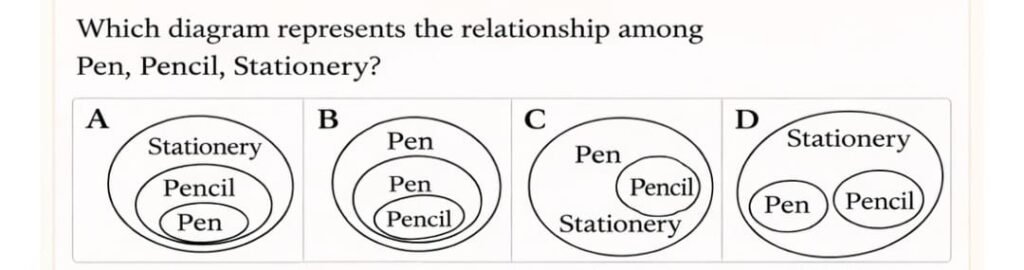
77.
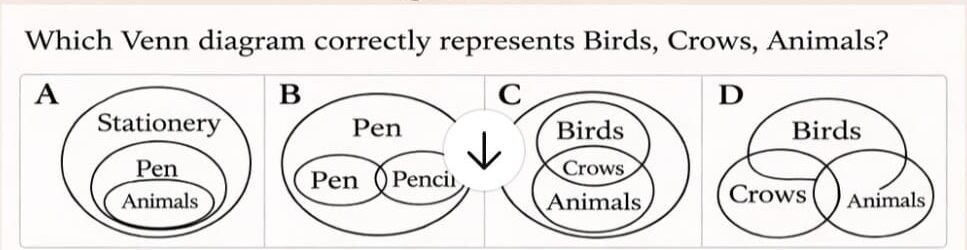
78.
79. In a row of 45 students, A’s rank is 15th from the top. What is his rank from the bottom?
(a) 30th
(b) 31st
(c) 29th
(d) 32nd
80. In a group of 60 people, 27 like cold drinks and 42 like tea, and each person likes at least one of the two drinks. How many people like both tea and cold drinks?
(a) 7
(b) 9
(c) 12
(d) 15

Free UPSC Materials
Prelims | Mains | Interview

Heartfelt congratulations
Cheers to our achievers!

UPSC CSE Courses
Comprehensive UPSC CSE Courses: Your Gateway to Civil Services Success!

UPSC Interviews
Expert Tips, Mock Sessions, Real Results

UPSC Test Series
Test Your Skills, Track Your Progress

UPSC Answer Writing
Master UPSC Answer Writing for Precision and Clarity!

UPSC PYQs
Crack UPSC with Comprehensive PYQs Practice!